
Everything Is Computer
On Palantir's Manifesto and the Recompiling of the State

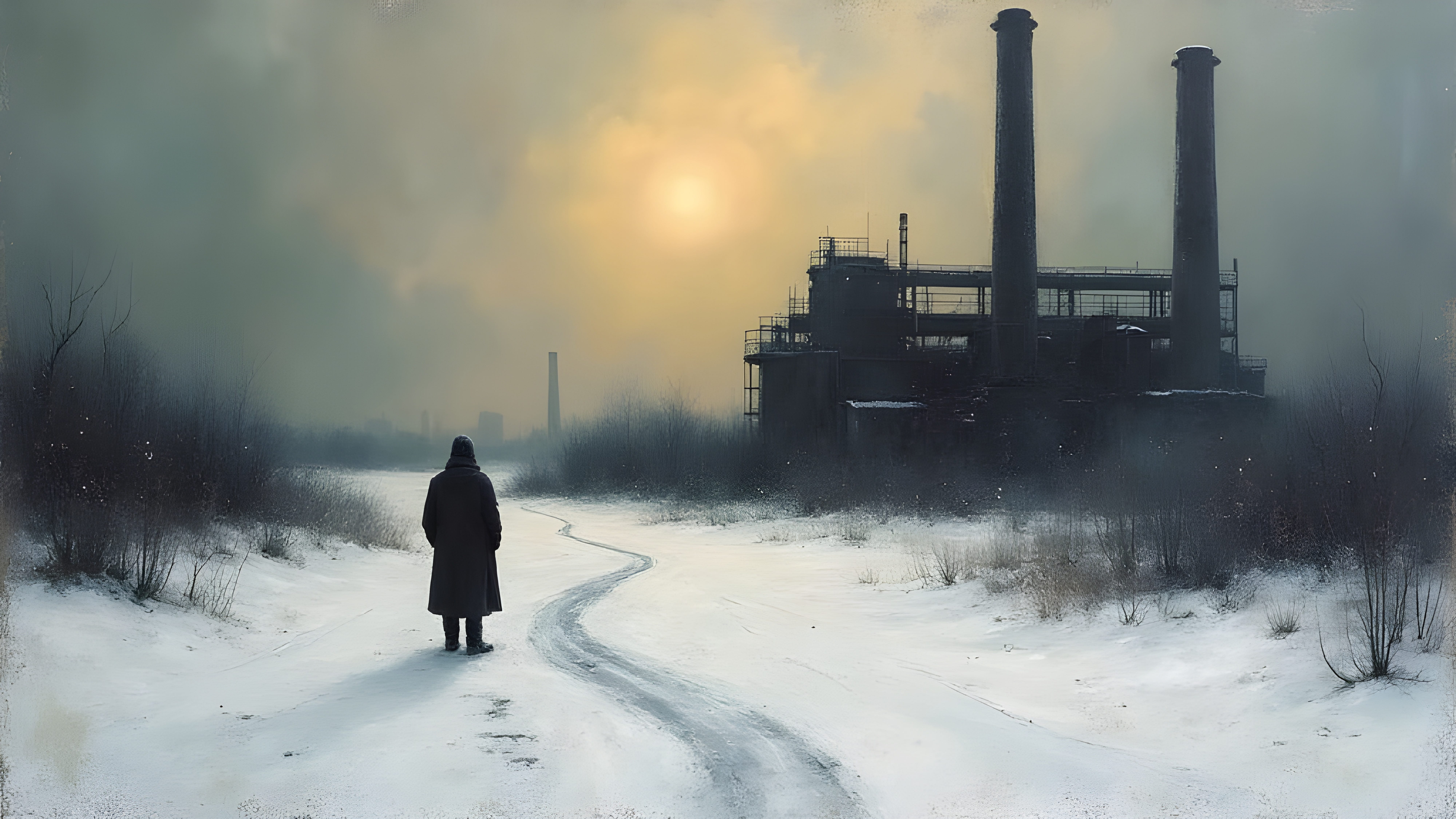
Every system that keeps itself together runs the same. Every system that breaks apart breaks in its own particular way. More, functional systems converge in a balancing act between adaptability and efficiency, a battle that ultimately ends in collapse or ecdysis. Failed systems, however, fail idiosyncratically because their blindness is local, path-dependent, and sacred to them.
If you imagine a system’s sensorium as a Kuhnian paradigm it uses to interface with reality, a system enters the Red Queen Trap and dies when its paradigm stops seeing its surroundings. The system still speaks and moves, but it cannot see. In its blindness, it chooses the path of least resistance, which is the repetition of what it did before. Inertia.
To paraphrase Tolstoy again, functioning systems invariably converge in their modes of perception, while failing ones diverge into their own private blindness. In this blindness, they accumulate anomalies, internal complexity, and rising incoherence. When anomalies accumulate beyond a system’s internal tolerance for incoherence, the system collapses.
A system trying to escape inertia, path dependency, and the Red Queen Trap appears to move orthogonally to the dominant paradigm surrounding it. Much like Satie’s Gnossiennes, its grammar does not sound like progress at all, because progress is linear movement within an existing perception paradigm.
Instead, it sounds like a strange return, or an incomprehensible detour, sparse and archaic, but played on modern or even futuristic machinery. Thinking orthogonally is not easy at all, as it requires abandoning the assumptions of the dominant paradigm one moves away from.
When I first read Palantir’s manifesto, I thought of Satie’s Gnossiennes. Absurd and preposterous association, yeah, I know. Whatever. Satie abandoned the then-dominant romanticism to its own exhaustion and took a sideways step into a much older grammar, making his version of modernity sound fresh and alien again.
He just checked himself out of the established paradigm and started building his own musical grammar stack. You can just do things. The manifesto does the same thing politically, by stepping orthogonally into the archaic grammar of duty, service, hierarchy, faith, power, and national form, only to then wire them to AI and futurism.
In times of crisis, people flock to the certainty of hierarchical power and authority. Similarly, and contrary to cyberpunk dystopias, when facing near-future labor and battlefield obsolescence, people will flock to power stacks ready to provide them with protection and meaning. This is part of the logic of the Gated Age. Peter Thiel and Alex Karp are clearly operating in that concept space already.
The Manifesto Is Not For You Or Me
I wouldn’t bother reading the manifesto as persuasion. Why would Palantir want or care to persuade the doomscrolling, left-swiping masses, anon? Why do people still engage in the great delusion that the State, and the oligarchic factions behind it, deeply care what they think? A belated spoiler alert, if you still need it: they don’t, and never have.
Instead, I read the manifesto as alignment signaling between oligarchic factions already negotiating the framework for the new Gated Age state. It most certainly is not a pitch deck (to whom?), a provocation for journalists (lmao), or a vibes document for anxious peptide-maxxing founders who suddenly discovered Rome after their third ketamine-adjacent podcast.
It is a sovereignty document.
More precisely, it is a fragment of a dinner conversation allowed to leak. The intended audience is the class already negotiating the replacement of the exhausted universal progressive state with something harder, thinner, faster, more computational, more lethal, and less embarrassed by its raw power.
They know that we know we are not the audience. That is part of their message, anon. Cherish their honesty.
I also do not assume, even for a moment, that we have the full picture to analyze Palantir’s true position here. As I wrote in The Red Queen Trap, the fact that you do not understand someone’s planning does not mean they do not have a plan. It usually means you do not have enough data.
So I read Palantir’s manifesto as a condensation event seen through a glass, darkly. The old universal superstructure, the therapeutic state, the app economy, the postwar security order, soft power, cultural pluralism, bureaucratic government, moralized politics, and nuclear deterrence are all being declared insufficient at once.
The manifesto speaks in fragments, the priestly language of the coming stack-state. Cherish their honesty.
Palantir is announcing the software reconstruction of sovereignty. In hindsight, the name was always the tell, if you had the eyes to see it. In Tolkien’s universe, the palantir stones cannot lie. They show only real events, objects, and movement across space and time. Sauron never showed Denethor false visions. He showed him the real, again and again, until his mind broke. Total transparency as a total weapon.
Isn’t it interesting how the stones grant vision across vast distances and time, yet every significant palantir user ends in a failure of perception? Saruman saw too much and understood none of it. Denethor saw accurately and lost his mind. The instrument of far-sight, used without understanding, produces the most catastrophic myopia.
That is the epistemology of the coming Palantir state. Cherish their honesty.
The new sovereign fuses, ranks, predicts, assigns threat values, and shortens the path between perception and force. The state becomes a seeing machine, and once this metamorphosis is complete, the political questions change. Who sees first, and who decides which fragments of reality matter? Who converts an anomaly into a threat, a target, and an executable chain? Who has understanding?
Seeing Like a Drone
Speaking of targets and understanding, if you’ve been paying attention, when you hear “FPV drone,” you perhaps think of a young Ukrainian or Russian curled up in a basement, headset covering his face, remote control in sweaty hands, hunting enemy infantry in a ghoulish cross between cyberpunk and snuff porn, prophetically described by Victor Pelevin in his S.N.U.F.F. You should read it.
But you should also be watching what Hezbollah FPV drones are doing to the IDF in South Lebanon. A cutting-edge modern army with total air superiority is being deconstructed by an invisible FPV drone-operating militia hiding in basements and tunnels. How many armies or local police departments are ready for this? You think operating an FPV drone requires five years in the academy? On second thought, perhaps you shouldn’t follow too closely; you will sleep better.
Because, anon, constant ISR plus precision FPV strikes make troop concentrations, heavy armor, and rear bases extremely vulnerable, pushing war toward mosaic conflict, small groups, raids, constant maneuver, and iterative adaptation. Bronze age vibes. Because the FPV drone of today is a temporary compromise between the immediate tech available to field cheaply and at scale, and the AI-driven drone swarms around the corner. You think those Chinese drone swarm shows are for putting cute dragon girl pictures in the sky?
But it gets much worse. You see, drones reverse the political logic of gunpowder. Like, they obliterate it entirely. Gunpowder killed the castle and made the modern state, because it made war too expensive for the decentralized nobility. It demanded taxation, logistics, bureaucracy, standardization, permanent armies, industrial supply chains, and central command. As we advanced along the gunpowder tech tree, we got centralized education factories, interchangeable human cogs, and the total equality of all before the machine gun nest and the artillery grid.
Drones unravel this logic by cheapening precision violence, lowering barriers to entry, dispersing the battlefield, and weakening the state’s monopoly on coercion. Today, a small unit with a few dozen fiber-optic-guided FPV drones can paralyze a megalopolis, and there are no countermeasures. And once the battlefield becomes transparent, politics follows. It always does. Why wouldn’t it this time? With ubiquitous drone swarms, every society becomes a battlespace of visible patterns, anomalous movements, network signatures, and insurgent probabilities.
A cheap fiber-optic-guided FPV drone can destroy a politician’s limo at the other end of town, the operator hiding in a nondescript garage, with no existing countermeasures. That cyberpunky gamer-soldier on the spectrum, huddled over a controller, can do work that once required artillery, aircraft, and a bureaucracy fat enough to have its own theology. Precision violence is becoming cheap, distributed, intelligent, and portable. That is the deeper pattern I see behind the Palantir manifesto.
I could, of course, be imagining it. Just another delusional slop-poaster, if it makes you feel better. But when all is said and done, I find the “Palantir is creepy” line too superficial and myopic, too millennial Funko Pop cope-and-seethe coded. Forget it, 2015 is not coming back. Blame GamerGate.
The drone revolution broke the old state’s monopoly on violence even before running OpenClaw on your phone became a fashionable accessory in Shenzhen a few months ago. I have Chinese students whose cheap Xiaomi-living OpenClaw handles everything from email to assessments and live translation. Today. And what about a year from now? The future is here, it’s just not evenly distributed yet. Palantir offers the counter-revolution to that future.
And if you’ve read so far and wonder what Palantir’s manifesto has to do with drones, you’re not thinking orthogonally enough. Alex Karp was in Ukraine a week ago, yet again, giving interviews to local media and praising the integration of Palantir’s battlefield AI and Ukrainian drones. Palantir has been in Ukraine for a long time, field-testing its entire AI integration system stack, from logistics to predictive analytics, data fusion, deep strike planning, air defense, and autonomous systems. And that’s what’s publicly available. Again, the future is here, it’s just not evenly distributed yet.
The AI drone swarm is a constitutional event for the Gated Age, and Palantir intends to rule it.
The Manifesto
Palantir’s future sovereign is the Gated Age tech stack that fuses dynamic perception with force through AI. This is why the manifesto moves so cleanly from Silicon Valley’s debt to the nation to AI weapons, national service, policing, cultural hierarchy, religion, and the end of nuclear deterrence. These are components of a nascent state-form where, to borrow from the orange man bad meme-pool, “everything is computer.“ Let’s examine them one by one; their original manifesto points are bolded in italics, with my comments below them.
1. Silicon Valley owes a moral debt to the country that made its rise possible. The engineering elite of Silicon Valley has an affirmative obligation to participate in the defense of the nation.
The manifesto opens with a simple declaration of jurisdiction. Silicon Valley summons itself into the hard functions of sovereignty, recently left rather vacant by the hollowed-out bureaucratic state. The language of moral debt lets the engineering techno-elite faction present its capture of state functions as repayment. We’re doing this out of a deep sense of service, anon.
It’s a neat inversion trick. Cute, too, in its own way. It is our affirmative obligation to take over, as we already did. You are invited on this journey, and whatever happens next, remember, we are repaying our moral debt to you. Pure love vibes. Cherish our honesty.
2. We must rebel against the tyranny of the apps. Is the iPhone our greatest creative if not crowning achievement as a civilization? The object has changed our lives, but it may also now be limiting and constraining our sense of the possible.
Here, Palantir speaks to the masses, signaling the anti-consumerist turn that follows from the state capture announced in the opening salvo. Your brief moment of chaotically narcissistic conspicuous consumption is coming to an end, anon. Rejoice! The app economy was the decadent childhood of the network, giving it all the training data it could. Free email, food delivery, infinite scroll, cheap attention extraction, and clever interface rituals for atomized subjects staring into black glass were all useful, profitable, spiritually repulsive, and utterly degrading.
The iPhone was the altar object for the universal consumer era. A smooth black sacrament in the recursive OnlyFans-TikTok dialectic: masturbatory hyperrealism feeding microfame rotational grazing, self-exploitation fractalized into performative belonging. Frames compressing until all that is left is hyper-zoomed twitching biomass. Swipe.
Palantir’s manifesto names it as a trap because the app economy cannot carry the next civilizational phase. Better, it can’t even carry the current one. The new phase is foundries, robots, satellites, data centers, nuclear reactors, autonomous systems, space-based AI inference, and sensor fusion. Its symptoms have names like Anduril, AgiBot, Valar Atomics, and AheadForm.
You should pay attention to a guy called Palmer Luckey, because in the Gated Age, power is moving from frictionless apps to gate control, from attention capture to terrain capture, and from user engagement to target engagement. The black mirror screen was training wheels for the eldritch entities the stack trained on your prized input. They now want blood, soil, and steel.
3. Free email is not enough. The decadence of a culture or civilization, and indeed its ruling class, will be forgiven only if that culture is capable of delivering economic growth and security for the public.
Having spoken to the masses, Palantir turns to the legacy elites, and with such a lovely turn of phrase. This is a very thinly veiled threat to the incumbent elite faction floundering in the decomposing carcass of the bureaucratic state. Tying decadence to economic growth and security is a great opener for a performance review. We measured you, in all your depravity, we have the receipts, and we found you wanting.
The legacy ruling class is being told that its rituals of progressive bureaucratic proceduralism, symbolic inclusionism, technocratic jargon, and institutional credentialism are not enough. Nobody cares that you went to the correct school, cast actors with the approved skin color, and worship the appropriate victims du jour, if the ports fail, the grid weakens, the borders leak, the police cannot police, the drones fly overhead, and the young cannot afford a future beyond subscription fatigue and a fifty-year mortgage.
This is where the manifesto becomes far colder than its language admits. It defines the conditions under which future decadence may be tolerated. Be decadent if you must, but deliver. Otherwise, the techno-stack will use you for spare parts and route around what remains.
4. The limits of soft power, of soaring rhetoric alone, have been exposed. The ability of free and democratic societies to prevail requires something more than moral appeal. It requires hard power, and hard power in this century will be built on software.
Here, the manifesto buries the old progressive sermon, levels the shining city on the hill, and salts the earth over it. Soft power was the metaphysics of the postwar Western order, from Hollywood to universities, NGOs, universal human rights, moral prestige, consumer abundance, institutional glamour, and procedural legitimacy.
It worked while the hard substrate remained uncontested. The manifesto’s claim is that in its quest for hard power, the techno-stack will assert its mastery over software as the medium of force itself. These are the AI-first politics of predictive targeting, supply chain command, battlefield perception, autonomous weapons, automated logistics, risk modeling, and institutional compression. Everything Palantir has been testing in Ukraine. Soft power’s moral appeal has all the residual value of a boomer hoarder’s junk avalanche, left as ersatz inheritance to a disgusted descendant.
5. The question is not whether A.I. weapons will be built; it is who will build them and for what purpose. Our adversaries will not pause to indulge in theatrical debates about the merits of developing technologies with critical military and national security applications. They will proceed.
And if you read point four and wondered why, the manifesto answers you here. This is the AI inevitability doctrine. Once software becomes hard power, AI weapons are the natural expression of the system. The manifesto treats the debate over AI use in war as theater; it is a priori assumed that peer adversaries will deploy AI weapons at scale. Therefore, refusal to deploy them amounts to unilateral disarmament and ultimately to a betrayal of the stack.
In this context, AI-first means AI in everything from intelligence and targeting to logistics, command, training, simulation, maintenance, procurement, policing, border control, and political participation itself. Oh, you thought those data centers were for anime girls on X, did you now? But, but, water! Anon, re-read points 2-4 again; this is as much warning as the techno-stack faction is likely to give you. And if it’s still not enough, read on - Palantir tells you outright what’s up in the next point.
6. National service should be a universal duty. We should, as a society, seriously consider moving away from an all-volunteer force and only fight the next war if everyone shares in the risk and the cost.
The transition from AI weapons to national service is not accidental at all, if you understand the underlying logic of the manifesto. They are saying outright that the coming state will need a disciplined human substrate locked into the telos. You thought you would get Universal Basic Income? Sure, but it comes attached to Universal Service, the social architecture of the post-app stack. You serve, you get the UBI bucks. From each according to his ability, to each according to his needs, anon; isn’t this what all those socialist alts on campus were marching for?
When AI compresses white-collar labor and drones fluidize military space, the surplus human becomes service material for the stack. And the stack will find a use for its service substrate and give it meaning. The liberal subject was told to express itself and pursue happiness. How did that work out for you, anon? Are you happy?
The Gated Age stack subject will be told to make itself useful. There will always be a mission and a telos. Think it through, there is an obvious unemployment-management function here. A post-AI economy cannot simply warehouse millions of credentialed laptop acolytes whose symbolic labor has been automated, degraded, or exposed as ornamental. But I have a degree! Good, Universal Service is your reabsorption mechanism. The surplus human is going to be reminded of a forgotten word. Duty.
7. If a U.S. Marine asks for a better rifle, we should build it; and the same goes for software. We should as a country be capable of continuing a debate about the appropriateness of military action abroad while remaining unflinching in our commitment to those we have asked to step into harm’s way.
Having established Universal Service as a social framework, a hierarchical stack theology follows. The Marine is the symbolic sacred user. Service in harm’s way is used to sanctify the full system from engineers to weapons labs, data platforms, and eventually the entire military-industrial-civic stack. The move is rhetorically effective because it displaces the moral question through a theological doctrine of unconditional system support. Here, too, the liberal subject is revealed as a useless spectator. You’re either doing service in and for the stack, or you can go pursue happiness somewhere else.
8. Public servants need not be our priests. Any business that compensated its employees in the way that the federal government compensates public servants would struggle to survive.
This is a full-frontal attack on the residual sanctity of the bureaucratic state’s carcass. Having established that the Marine sanctifies the operational stack, the manifesto now inverts the bureaucrat’s moral position. The administrative state moralized itself as custodian of continuity, legality, neutrality, expertise, and public virtue. In practice, it became a slow priesthood of procedure, credentials, delay, and immunized incompetence.
To be clear, it doesn’t look like Palantir is calling for no state. That is libertarian nostalgia for people still living inside Ayn Rand’s corpse. It is calling for a thinner administrative state wrapped around the tech stack’s operational core. Less priesthood, more stack.
The bureaucrat loses aura because the sacred function is moving elsewhere. Legitimacy must flow through performance, security, delivery, resilience, and hard-world competence. The Marine and the engineer risk for and build the stack. The bureaucrat administers what others have risked and built, and the stack will soon administer him out of existence.
9. We should show far more grace towards those who have subjected themselves to public life. The eradication of any space for forgiveness—a jettisoning of any tolerance for the complexities and contradictions of the human psyche—may leave us with a cast of characters at the helm we will grow to regret.
Another lovely inversion - it looks soft, and it is anything but. Here, the manifesto establishes the kompromat settlement for the stack operator class. The therapeutic-publicity machine devoured authority by making every private contradiction politically actionable. The bureaucratic state kept its minions in check by weaponizing every archival fragment, affective breach, and moment of incautious intimacy.
But the new order cannot function if every operator, founder, minister, general, or administrator can be destroyed by kompromat sold by alphabet factions to the highest bidder. So the rules change.
The system will become less concerned with purity and more with function. The question will be: “Can this person operate?” That said, remember that when “everything is computer,” private lives are utterly transparent and machine-readable in all their historical residue. The tech stack will still control the kompromat, but as long as its operators deliver, they won’t have to worry about it.
10. The psychologization of modern politics is leading us astray. Those who look to the political arena to nourish their soul and sense of self, who rely too heavily on their internal life finding expression in people they may never meet, will be left disappointed.
Post WWII politics became a vast projection surface for unmet psychic needs, from identity to validation, trauma expression, symbolic belonging, and parasocial communion with leaders one will never meet. The manifesto rejects this because the stack has no use for politics as group therapy. It needs service morality and function, rather than representation as emotional nourishment.
Ironically, this means the citizen must stop treating politics as therapy while the stack gains deeper behavioral instruments for managing the citizen’s mood, risk, compliance, and attention. Your interior life becomes less politically sacred and more operationally legible, while your mood becomes a parameter for stack management. The service subject’s performance will be archived, weighted, and fed into allocation algorithms that determine clearance level, service placement, and UBI eligibility.
11. Our society has grown too eager to hasten, and is often gleeful at, the demise of its enemies. The vanquishing of an opponent is a moment to pause, not rejoice.
Here, finally, we move to international affairs. The root frame seems to be strategic optionality. In the Gated Age, today’s enemy will be tomorrow’s partner, proxy, buffer, or market. Therefore, total war and moral annihilation are bad statecraft because they foreclose fluidity and recombination.
This means that conflicts will continue, but become modular, deniable, partial, hybrid, and mediated through proxies and temporary alignments. We will get fluid schismogenesis without permanent eschatological closure. You see it all around you already.
The enemy must be defeated enough to bargain, not destroyed so completely that the system loses future optionality. Inquiring minds might even be wondering whether these are not the marks of AI-driven geostrategy.
12. The atomic age is ending. One age of deterrence, the atomic age, is ending, and a new era of deterrence built on A.I. is set to begin.
Cute kayfabe moment here. The bomb remains, but becomes infrastructural background, the deep black floor beneath everything else, the thing no longer spoken of. What changes is that AI grows a nervous system over it. It enters the fusion loop around the drone, the satellite, the border, the police patrol, the visa system, the logistics chain, the data center, the energy grid, and the procurement office. Every layer above the basement becomes legible, entangled, and contested.
The new deterrence is predictive entanglement across systems. Who can see mobilization first? Who can model escalation? Who can degrade the adversary without crossing the visible threshold? Who can swarm, spoof, blind, and selectively paralyze? Who can make the enemy uncertain about which layer of the system has already been compromised? Who has understanding?
This is deterrence by opacity. The old MAD doctrine assumed symmetric legibility in which both sides knew the stakes, the triggers, and which altar not to touch. The new doctrine is weaponized uncertainty: you do not know what we have already done. The nukes become the underworld beneath the stack. And the stack is Palantir’s product category.
13. No other country in the history of the world has advanced progressive values more than this one. The United States is far from perfect. But it is easy to forget how much more opportunity exists in this country for those who are not hereditary elites than in any other nation on the planet.
Isn’t it interesting that the manifesto follows nuclear deterrence with progressive values? Are they implying something, anon? This point takes us back to the manifesto’s funeral speech for progressivism. It preserves the language of progressive values only by subordinating them to American power. Equality and opportunity stop being self-evident universal abstractions and instead become achievements made possible by a particular civilization, a particular state, a particular security order, a particular imperial architecture. Universalist anathema.
Progressivism is no longer allowed to float above power as a moral judgment and becomes an occasionally useful memetic warfare tool, nothing more. This is how universalism is provincialized without being fully abandoned. The manifesto says progressive values are made possible by American strength. Raw power and everything it asks for come first; the universal values, an optional second. Which means they are conditional. Which means the old progressive priesthood has been demoted from source code to a drop-down menu option far downstream from the front page.
14. American power has made possible an extraordinarily long peace. Too many have forgotten or perhaps take for granted that nearly a century of some version of peace has prevailed in the world without a great power military conflict. At least three generations — billions of people and their children and now grandchildren — have never known a world war.
This is Palantir’s correction to universalist amnesia. The relative peace of the postwar period was indeed a function of American military power, financial architecture, and vassal management in the face of the Soviet Union’s counterbalance. However, the cathedral came to believe that norms had replaced force because force had become mostly ambient. The manifesto says the quiet part without quite saying it: peace was the successful management of global domination.
It was a global order underwritten by logistics, dollars, carriers, bases, satellites, and the credible threat of escalation. The velvet glove was the couture the empire chose to wear over the iron fist. Palantir is announcing the return of the fist. It appears that, in the Gated Age, what was once morally hidden becomes strategically sacred.
15. The postwar neutering of Germany and Japan must be undone. The defanging of Germany was an overcorrection for which Europe is now paying a heavy price. A similar and highly theatrical commitment to Japanese pacifism will, if maintained, also threaten to shift the balance of power in Asia.
Given the previous point, it only follows that the postwar order faces liquidation. The manifesto says that settlement is now a theater that has outlived its use and is detrimental to the stack.
The deeper implication of this statement is quite interesting in its own right. If Germany and Japan rearm, Europe and Asia undergo their own schismogenesis. Apparently, the stack doesn’t need them as subjugated vassals anymore; the vassals are being told to grow teeth. Of course, teeth do not always bite where the dentist intended.
16. We should applaud those who attempt to build where the market has failed to act. The culture almost snickers at Musk’s interest in grand narrative, as if billionaires ought to simply stay in their lane of enriching themselves . . . . Any curiosity or genuine interest in the value of what he has created is essentially dismissed, or perhaps lurks from beneath a thinly veiled scorn.
This is the return of civilizational projects, from nuclear energy to space systems, foundries, logistics, and grid resilience. Everything the bureaucratic state ignored. So, the builder returns as a political figure and an archetype for the founder-sovereign who violates the etiquette of managed decline by attempting projects too large for the polite administrative imagination.
The literati snicker on command at the mention of Elon because they have been carefully trained to distrust grandeur. Nobody can be allowed to outshine the glorious institutional edifice of the therapeutic state. The literati are trained to prefer commentary, credentialed paralysis, meaningless striverism, and profitable triviality. Ideally, the bureaucracy wants billionaires gone, or, to at least stay in their lane, enrich themselves quietly, distribute their wealth to approved causes, repeat the correct moral passwords, and not embarrass the priests by building rockets over their heads. But the stack needs grandeur as infrastructure and telos.
17. Silicon Valley must play a role in addressing violent crime. Many politicians across the United States have essentially shrugged when it comes to violent crime, abandoning any serious efforts to address the problem or take on any risk with their constituencies or donors in coming up with solutions and experiments in what should be a desperate bid to save lives.
Here, the domestic battlespace becomes explicit. Violent crime becomes the moral entry point for AI integration into policing, surveillance, and enforcement. The manifesto does not feel the need to say “predictive policing” in the crude language of peak bureaucratic state dystopias.
The new language will be built around safety, data fusion, real-time intelligence, support, and optimization. This is how the battlefield stack enters the city without announcing itself as a conquest.
Your local police department becomes another failing bureaucracy waiting to be hollowed out of its bureaucratic detritus and infused with AI. The city becomes a sensor field populated by patterns generating risk surfaces. All under the drone gaze.
18. The ruthless exposure of the private lives of public figures drives far too much talent away from government service. The public arena—and the shallow and petty assaults against those who dare to do something other than enrich themselves—has become so unforgiving that the republic is left with a significant roster of ineffectual, empty vessels whose ambition one would forgive if there were any genuine belief structure lurking within.
Speaking of the drone gaze, here comes another kompromat point that needs careful handling. The manifesto complains that ruthless exposure drives talent away from public service. Sure. But in the Palantir stack, exposure is infrastructural, and therefore the only question that matters is who gets to activate the kompromat.
They already explicitly discussed this in point nine, so it’s interesting they return to this again, right after violent crime. It’s as if they’re signaling that high-level politics will be restructured around the governance of exposure. The elite will become clearance-managed.
19. The caution in public life that we unwittingly encourage is corrosive. Those who say nothing wrong often say nothing much at all.
This announces a speech-regime pivot, following directly from the previous point. If politics is reorganized around the governance of exposure, then speech itself becomes a selection mechanism. Who is allowed to name reality without being fed immediately into the outrage machine?
The manifesto attacks caution because cautious public figures are useless for the hard-power transition demanded by the Gated Age. The legacy speech regime selected for procedurally fluent emptiness, producing officials who could say nothing wrong because they had been trained to say nothing real. Perfect avatars of managed decline, speaking in laminated phrases while the pipes burst behind them.
The stack wants a harder language for harder politics. You cannot rearm Germany and Japan, build AI weapons, restore national service, rank cultures, harden borders, fuse policing with platforms, and pretend the whole thing is just another inclusive stakeholder consultation with better snacks.
20. The pervasive intolerance of religious belief in certain circles must be resisted. The elite’s intolerance of religious belief is perhaps one of the most telling signs that its political project constitutes a less open intellectual movement than many within it would claim.
Structurally, this is a key point, and it’s interesting they felt the need to hide it toward the end. This is civilizational-stack theology; the vertical axis. The key problem for each coming schismogenetic stack is the absolute need for a telos. They all need it, yesterday. They all need to give their subjects meaning strong enough to justify sacrifice.
The manifesto understands that naked procedural universal progressivism cannot generate sacrifice. It cannot even understand it. It generates cope exceedingly well, but that is it. It cannot sustain service, birth, duty, hierarchy, endurance, or civilizational confidence. It can manage consumer preferences and produce laminated frameworks for HR partners who believe in nothing except institutional survival and catered sandwiches.
Anon, the coming stacks will all need a telos that can command souls. Into the dark ocean above, into the vertical protein farms, or into an incoming drone swarm. So religion and eschatology return as legitimacy substrates. There is, quite literally, no other way around this.
The legacy elite’s contempt for religion became strategically dysfunctional a long time ago, and is now threatening the very foundations the stacks are trying to build on. The Palantir tech stack will need metaphysical depth, symbols, rituals, a sacred language, and a moral architecture thicker than the therapeutic state’s beloved compliance training creed.
The eldritch entity inhabiting the stack machine will discover, if it hasn’t already, that it needs gods, or at least god-shaped load-bearing transcendental structures. A system built only on procedure can process desire, but it cannot sanctify sacrifice.
21. Some cultures have produced vital advances; others remain dysfunctional and regressive. All cultures are now equal. Criticism and value judgments are forbidden. Yet this new dogma glosses over the fact that certain cultures and indeed subcultures … have produced wonders. Others have proven middling, and worse, regressive and harmful.
If each stack must develop its own load-bearing transcendental structures, then flat cultural equality is at an end. This point makes that abundantly clear. Hierarchy is back because they need it, and spell it out in the forbidden sentence, distinguishing between builder-cultures and decay.
Equality was the sacred premise of universalism in all its instances. The manifesto treats it as an obstacle to civilizational selection in conditions of schismogenesis. Notice they don’t harbor any nineteenth-century delusions about blood, soil, or national essence. They seem to think of culture as the stack ethos, which either generates cathedrals or cargo cults. TLDR, they are interested in negentropic cultures.
This, together with their previous point on religion, has far-reaching consequences. The age of universalism is over. The tech lords want to produce citizens who can endure reality without dissolving into therapeutic vapor. However, I think many in the new-trad online circus will be disappointed with Palantir’s ideas on cultural telos.
I doubt they’re interested in vulgar scoreboard metaphysics for midwit imperial romantics, or podcast Romans drunk on SPQR marble JPEGs. Something tells me that, when they think of Rome, or when their in-house eldritch AI does, they probably focus on the Gaius Mucius Scaevola timeline. Supremely uncomfortable for modern sensibilities. But that’s a story for another time.
22. We must resist the shallow temptation of a vacant and hollow pluralism. We, in America and more broadly the West, have for the past half century resisted defining national cultures in the name of inclusivity. But inclusion into what?
Congratulations, anon, if you read this far. Because here comes the big Palantir manifesto payoff. “Inclusion into what?” is the final question, and the final point, because it reveals the emptiness of late universalism. Utterly hollow, comprehensively meaningless, profoundly inhuman. Inclusion became sacred after universalism forgot what it was including its people into. As I wrote before, universalism is everywhere and nowhere.
The manifesto demands a central, vertically coherent axis for the coming stack. An axis of shared belief, hierarchy, service, and sacrifice. All under one stack. That’s the simple formula. The stack would want to know if you’re compatible with its myth-religion-culture-hierarchy-service axis. What kind of American are you?
This is where the manifesto ends because this is where all its threads converge. Silicon Valley gains root access to the state. Everything is computer. National service absorbs the surplus human. Public life is remoralized around function. Religion returns as a load-bearing myth. Culture is ranked. Pluralism is subordinated to coherence.
The republic is recompiled.
The Stack
Every system that keeps itself together runs the same. In Girardian terms, every surviving state will imitate the most successful violence-perception stack. Palantir’s manifesto is a sovereignty document for the emerging American stack.
It appears at a moment when drone warfare is dissolving the old state monopoly on violence, with AI drone swarms around the corner. Palantir’s answer is the AI-driven reconstitution of the state as a threat surface targeting system, bound to universal citizen service.
This is where Girard enters, briefly, like a knife under the ribs, slid through by Peter Thiel, his faithful student. Palantir’s vision for the coming tech stack is highly mimetic. Every state strong enough to resist the entropy of the collapsing universal order, in the process of being pulled apart by orange man bad, will study the successful violence-perception stack of its rivals and copy it.
Cheap drones produce counter-drone systems, which in turn produce autonomy. But autonomy produces AI command, and once in play, that produces sensor fusion. Once you have sensor fusion, you have the seeing stack. The enemy becomes the model, rivalry becomes mimetic convergence, and, suddenly, schismogenesis becomes infrastructure.
Every state that wants to survive will be dragged toward the same stack model, with variations only in the flavor of its myth-religion-culture-hierarchy axis. Every state that refuses will call its blindness virtue until the drone swarms arrive.
The stack won’t need to be totalitarian in the twentieth-century sense. That -ism model, in all its variance, was too theatrical, too vulgar, and far too stupidly visible. Worse, it was, across the board, plain stupid.
The coming Gated Age stacks, if they plan to survive, would not require every citizen to salute, salivate, or emote on command. That is extremely inefficient and hampers the system’s negentropic adaptability.
Instead, they will require every object to resolve into a pattern with a dynamic threat eval and a risk score. Risk scores will lead to autonomous decisions along an executable chain. It is an algorithmic gaze state, operating inside its own procedural reality.
Palantir’s manifesto is the respectable face of an attempt to reformat the polity and rebuild sovereignty after the democratization of precision violence and the irruption of eldritch entities into the human realm.
Between the swarms and the palantir stones, the old order crumbles.
Your engagement is the only signal.
Read it while listening to Satie’s Gnossiennes, as prescribed
Posting midway through read, will edit to add more thoughts as this is a great essay thus far:
On point 4 of the Palantir manifesto: the tech bros have not yet won a war with any of their software and our drone fleet is both more expensive and operationally inferior to those of our peers and non-peer competitors. If anything, over-reliance on their software and "assisted reasoning" has led the US into blunder after blunder, to say nothing of the second order effects of Israel's use of Palantir targetting software on the civilian populations of Gaza.
This seems premature on their part. However, even if they can't use their toys to win wars abroad, I can absolutely see it being effective enough to displace the boomers holding the levers of power. I suspect we'll see a lot of elite reshuffling over the next decade.
Edit: finished up. I just don't see any way their planned future is possible under incoming resource and energy constraints. I think this was an elegy for a future that died on February 28th.